
UNESCO CHAIR WRITTEN WORK COMPETITION: IDEAS FOR A KNOWLEDGE ECONOMY
The UNESCO Chair Written Work Competition is an academic initiative dedicated to encouraging students to explore the future of the Knowledge Economy in Central Asia. Organised under the UNESCO Chair on Knowledge Economy, the competition invites undergraduate students to move beyond theoretical discussion and develop practical, evidence-based ideas that can respond to real regional challenges.
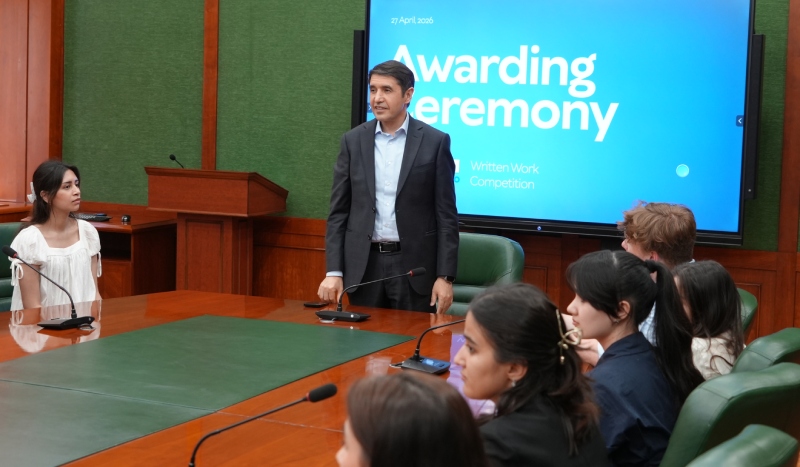
The 2025–2026 competition was held under the theme “Central Asia’s Knowledge Economy Pathway: Priorities, Obstacles, and Realistic Next Steps.” Students worked in teams of two and prepared joint academic and practical reports focusing on areas such as university-industry cooperation, intellectual property, digital education, innovation ecosystems, human capital, and other knowledge economy priorities. The format encouraged students to combine research, diagnosis, and implementation: one part of the work focused on identifying key legal, social, or economic obstacles, while the other focused on proposing realistic next steps, stakeholders, timelines, and measurable outcomes.
A distinctive feature of the competition is its practical orientation.
Students are encouraged not only to analyse problems, but also to design solutions that could be adapted by institutions, policymakers, or development actors. At the conclusion of the competition, the strongest submissions are recognised through first, second, and third place awards. Beyond prizes, the competition gives students a valuable opportunity to strengthen their research skills, develop policy-oriented thinking, and contribute fresh ideas to the region’s transition toward a more innovative, inclusive, and knowledge-based future.
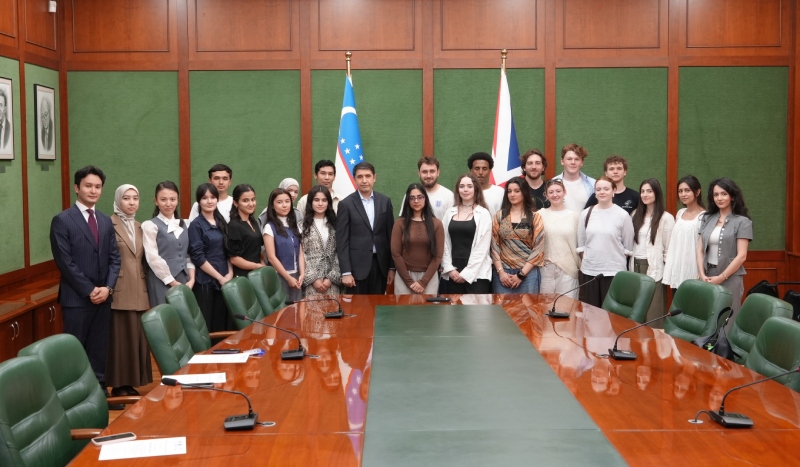
2026 Written Work Competition Winners
The UNESCO Chair on Knowledge Economy at WIUT proudly recognises the winners of the 2026 Written Work Competition, dedicated to student research on the future of the knowledge economy in Uzbekistan and Central Asia. The competition encouraged students to explore real challenges, develop evidence-based arguments, and propose practical pathways for building a more innovative, inclusive, and knowledge-driven society.
On 27 April 2026, certificates were awarded by Dr. Komiljon Karimov, Rector of WIUT and Chair Holder of the UNESCO Chair on Knowledge Economy, to six outstanding student researchers whose works demonstrated strong analytical thinking, originality, and relevance to the region’s development priorities.
Authors: Lutfullo Akhmedov and Mashhura Rahmatullayeva
Programmes:
Lutfullo Akhmedov — Economics with Data Science, Level 4
Mashhura Rahmatullayeva — Economics with Finance, Level 4
Paper Title: Graduate Employability Crisis in Uzbekistan
Pathway: Human Capital and the Knowledge Workforce
This winning paper examines one of the most pressing questions for Uzbekistan’s knowledge economy: how to ensure that university graduates are equipped with the skills, experience, and opportunities required by a changing labour market. By focusing on graduate employability, the authors address the connection between education, human capital, workforce readiness, and long-term economic transformation.
Impact Statement:
Uzbekistan is self-educating at such a rate that the economy can not absorb it. The higher education institutions of the country produce over 170,000 graduates each year, the majority of which get degrees in engineering, economics, information technology, and the natural sciences (State Statistics Committee of the Republic of Uzbekistan, 2023). The tertiary education sector in the country has grown exponentially in the last ten years, by any criteria of enrolment or credential attainment. But the graduate unemployment rate remains at around 18 percent, and the proportion of formally employed in the knowledge-intensive job sector also is also one of the lowest in the Eurasian region (World Bank, 2023). The irony is not hidden: increasing education is making people less competent at least not so that a knowledge economy needs them.
This mismatch does not inconvenience. It threatens the development path of Uzbekistan on the structural level. The Uzbekistan 2030 strategy of government is categorical regarding the goal: to shift to an economy that relies on commodities, labour surplus, and instead serve high-value services and human capital. The strategies of human capital can be effective, however, only when the skills that are produced are matched with the capabilities, which productive, knowledge-intensive employment requires. Currently they no longer do. Graduates testify to putting their feet in the labour market without the analytical, digital, and applied technical skills that employers in growth industries finance, software, advanced manufacturing, agribusiness demand the most (Asian Development Bank, 2022). On their part, employers invest in informal re-skilling programmes because they do not believe that the acquisition of degrees is an indicator of relevant capability.
The cost of inaction is not abstract. Failure by graduates to secure jobs that match their qualification leads to wastage of human capital when it is needed to fetch returns the most. Youths who had spent years of their lives in education end up demoralized; some of them abandon their homes and capitalize on the brain drain process. Companies unable to recruit skilled labour either hold up, or succeed with a low-cost labour force, or use imported skills - none of which is conducive to the productivity benefits on which a knowledge economy thrives. The skills gap is a direct pull-back to the economic transformation path of a country that is in the midst of a big reform cycle, as it is the case in Uzbekistan.
This paper will look at graduate employability crisis in the labour market of Uzbekistan: how big a problem it is, how it has come about and what can and actually be done about it. It relies on international experience to diagnose the reasons why the gap is there and what types of interventions have been successful in similar environments. It then transforms such analysis into a concrete, practical suggestion to a practical institutional actor. The stakes are so great that it is worth this degree of specificity: in case Uzbekistan is serious about developing a knowledge economy, it needs to create one that can support a workforce in such an economy.

